Repurpose Baby Monitor for Pet Monitoring: Range Guide
By Elias Ortega • 2nd May
Why Baby Monitors Might Work for Pets - And Where They Fall Short
The question sounds practical at first: you've already invested in a baby monitor, so why not use it to watch your dog or cat when you're at work? The answer sits squarely at the intersection of baby monitor pet monitoring principles and hard wireless physics. Baby monitors and pet surveillance cameras solve different problems, and conflating them without measuring real-world performance can leave you with blind spots exactly when you need line-of-sight clarity.
I've spent years in real homes testing how these devices hold a link through walls and floors. For a deeper breakdown of how materials like plaster, brick, or metal studs affect coverage, see our home construction range guide. What I've learned is simple: walls, floors, and microwaves tell the truth, not spec sheets. Let me walk you through the technical trade-offs, the range implications, and whether a baby monitor can actually serve as a reliable pet surveillance setup or if a dedicated solution is the only choice that will not leave you guessing.
The Core Technical Differences
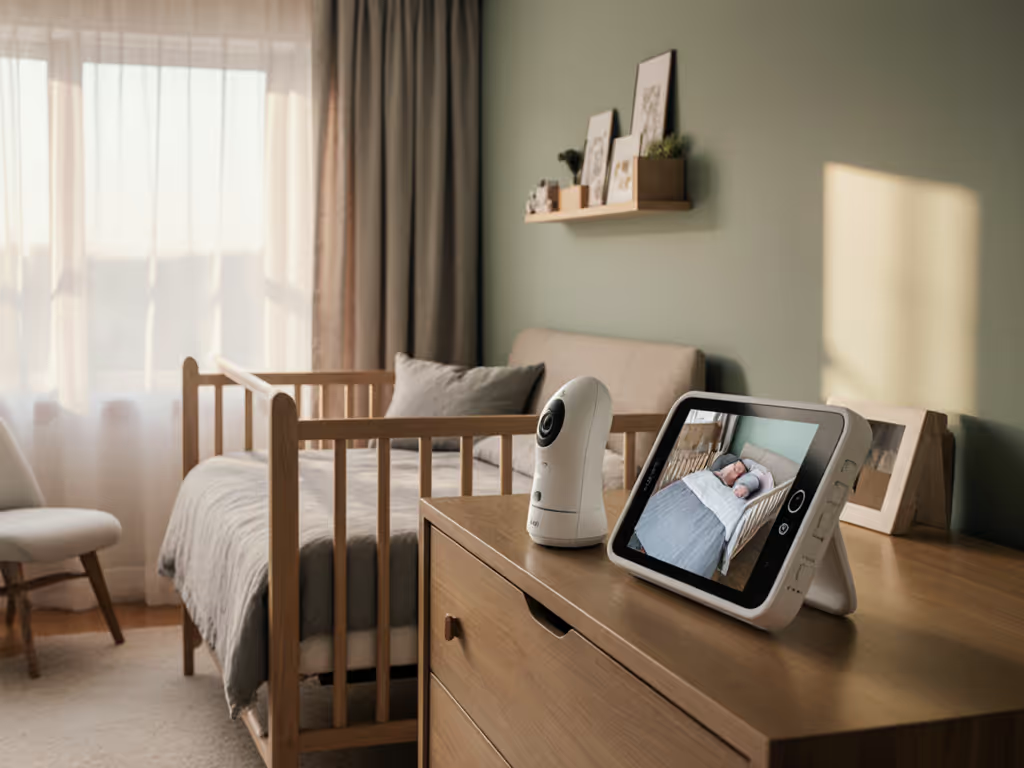
Baby monitors historically prioritize low latency (typically 150 to 400 ms for video) and closed-loop operation, maintaining a dedicated parent-unit receiver and camera pair, often using DECT (2.4 GHz, frequency-hopping), proprietary Wi-Fi links, or local FHSS (Frequency-Hopping Spread Spectrum) protocols. The VTech 5-inch Smart Wi-Fi monitor, for example, connects via the MyVTech app and uses Wi-Fi, meaning it relies on your home network, and therefore shares airspace with dozens of other devices.
Pet cameras, by contrast, are designed for asynchronous access: they stream via cloud services and often expect you to pull video on demand rather than maintain a permanent live connection. The Petcube Cam, for instance, offers 24/7 cloud storage and motion-zone alerts, but depends on persistent internet upload bandwidth, which a baby monitor may not be engineered to handle.
This distinction matters profoundly for range and reliability. A multi-use baby monitor that tethers you to Wi-Fi inherits your network's congestion, dropout patterns, and interference profile. If you're in a dense apartment or older building with brick or plaster walls, Wi-Fi models already struggle to maintain video across floors. Urban dwellers will benefit from our apartment signal tests with real-world dropoff data. Repurposing one for pets in a garage, basement, or outdoor run adds distance and material obstacles that Wi-Fi attenuation will punish, typically 3 to 5 dB per floor in residential structures, and 1 to 2 dB per heavy wall.
Range and Attenuation: What the Data Shows
A typical Wi-Fi-based baby monitor ships rated for "up to 900 feet" or similar marketing language. In reality, that assumes open air and no obstacles. Inside your home, effective range drops to 30 to 60 feet per floor on the same level, less through walls. If range is your blocker, our best long-range baby monitors roundup focuses on models that hold signal across floors. LeapFrog and Motorola Wi-Fi monitors operate under similar constraints.
For pet surveillance setup, this creates a hard choice:
- If your pet has a dedicated room indoors, a Wi-Fi baby monitor can work, but only if placed within 2 to 3 rooms of your router.
- If you want to monitor a pet outdoors (yard, patio, kennel), Wi-Fi drops off sharply. The parent unit's battery also becomes a liability: most baby monitor parent units run 4 to 8 hours on battery alone, not the full night or outdoor daytime watch you'd expect for a pet.
A dedicated pet camera, wired or powered continuously, avoids the battery trap and often uses dual-band Wi-Fi (5 GHz for proximity, 2.4 GHz for range) or cloud-native architectures that tolerate higher latency, a luxury baby monitors cannot afford.
The Interference Problem: Why Microwaves Matter
During a late-night support call with a frustrated parent, their baby monitor froze whenever they reheated bottles. A spectrum analyzer showed 2.4 GHz spikes from the microwave bleeding into the monitor's channel. Get mitigation steps and channel maps in our interference guide. Repositioning the camera antennas and reducing the distance between parent unit and camera fixed it. The lesson: physics wins over marketing every time, and it scales to pets too.
Baby monitors using FHSS or older DECT protocols have built-in frequency-hopping to dodge interference, but Wi-Fi models do not. If your household runs Wi-Fi routers, mesh networks, baby sound machines, cordless phones, or smart home devices on 2.4 GHz (and most do), you're sharing a crowded lane. A baby monitor already struggles in this environment; adding a pet camera feed exposes the same channel to further congestion.
Pet cameras designed for the task often use dedicated 5 GHz bands or cloud upload, sidestepping the 2.4 GHz free-for-all. A baby camera for pets application means you inherit all of this interference risk without the flexibility to switch protocols.
Latency and Real-Time Monitoring
Baby monitors aim for 200 to 500 ms latency to let parents respond quickly to cries or sounds. Pet owners monitoring for escapes, aggression, or signs of distress need comparable speed. Wi-Fi baby monitors can deliver this indoors on a strong signal, but as distance grows or wall count increases, buffering and packet loss degrade latency to 1 to 2 seconds or worse.
For most pet scenarios, checking in occasionally, spotting a dog pacing, or catching a cat on the counter, slight latency is acceptable. But if you're using animal behavior monitoring to assess stress or reactivity in real time, the lag becomes frustrating and diagnostically unhelpful.
Battery Life and Continuous Operation
A critical limitation: baby monitor parent units are designed to be portable. They run 4 to 8 hours on battery, ideal for naps or quick trips downstairs. To stretch runtime or pick a better power setup, use our battery life guide. For a pet surveillance setup, this is a dealbreaker. You'd be forced to keep the parent unit plugged in constantly, or rely on phone-based viewing via the Wi-Fi app, which drains your phone battery and requires your device to stay connected.
Pet cameras solve this by being stationary and mains-powered, accepting the trade-off of lower portability for continuous, always-on monitoring.
When a Baby Monitor Can Work for Pets
Repurposing makes sense only in narrow scenarios:
- Single-room monitoring: Watching a kitten in a spare bedroom while you're working downstairs. Keep the monitor within one large room, close to your router, and accept 200 to 400 ms latency.
- Short-term backup: A pet sitter is in the home; you want a quick way to verify they're checking in. The latency and range are less critical because the camera is indoors and proximal.
- Temporary travel setup: Bringing a portable baby monitor to a vacation rental to monitor a pet in a rental cabin. Acceptable if the layout is small and Wi-Fi is reliable.
Outside of these tight conditions, the compromises stack faster than the benefits.
A Quick Comparative View
| Factor | Baby Monitor (Wi-Fi) | Dedicated Pet Camera | Winner for Pet Monitoring |
|---|---|---|---|
| Outdoor/long-distance range | 30 to 60 ft indoors; poor outdoors | 50 to 200 ft; cloud fallback | Pet Camera |
| Continuous operation | 4 to 8 hrs battery; mains when available | Always mains-powered or wired | Pet Camera |
| Latency | 200 to 500 ms | 500 ms to 2 s (cloud-dependent) | Baby Monitor |
| Interference resilience | Mixed; Wi-Fi models vulnerable to 2.4 GHz noise | Varies; often uses 5 GHz or cloud | Depends on model |
| Initial cost | $150 to $400 | $30 to $200 | Pet Camera |
| Subscription (typical) | Optional cloud; many local-only | Often built-in cloud storage | Baby Monitor |
Summary and Final Verdict
A baby monitor can technically display a pet on-screen, but it sacrifices the core features pet owners need: always-on availability, outdoor range, and resilience to household interference. The fundamental mismatch stems from different design goals. Baby monitors prioritize low latency and portability for indoor nurseries; pet cameras prioritize continuous operation and outdoor durability.
Walls, floors, and microwaves tell the truth, not spec sheets. If you're tempted to repurpose a baby monitor to save money, measure first. Walk your pet's typical zones with your phone, run a Wi-Fi signal scan, and test video dropout during peak household Wi-Fi use. If your setup keeps a strong signal and you're monitoring a single indoors room, it might work. But if you need reliable outdoor visibility, multi-room coverage, or peace of mind during your pet's daytime or overnight hours, a dedicated pet camera designed for continuous operation and real-world interference is worth the additional investment.
The right tool is not the one you already own; it is the one that stays linked when it matters most.
Related Articles