Baby Monitor Insurance Benefits: Home Coverage & Discounts
By Amina Qureshi • 29th May
Using a baby monitor is primarily about safety and peace of mind, but many families are now asking how baby monitor insurance benefits fit into broader home risk management and whether home insurance baby monitoring can influence coverage or premiums. This FAQ deep dive walks through where monitors intersect with property protection, liability, discounts, and privacy, so you can make informed choices without turning your nursery into an underwriting data feed.
If it phones home, it needs a very good reason.
FAQ: Baby Monitor Insurance Benefits & Home Coverage
1. What are the main baby monitor insurance benefits?
In insurance terms, baby monitors provide indirect rather than direct benefits:
- Risk reduction: A functioning monitor can help you respond quickly to incidents (smoke, break-in noises near the nursery, a fall from a crib), potentially reducing the severity of a loss.
- Evidence for claims: Video or audio can serve as baby monitor claim documentation, clarifying timelines and what actually happened in the room.
- Signaling overall safety posture: In some markets, insurers consider the presence of safety tech (monitors, alarms, sensors) as part of a broader home safety monitoring insurance profile, especially when bundled in smart home programs.
However, monitors also introduce new risks:
- Cyber exposure if the device is cloud-connected or poorly secured.
- Privacy exposure if footage or metadata can be requested, subpoenaed, or silently harvested.
So the benefits are real, but they sit in tension with security and privacy. A good policy and device choice tries to harness the former without expanding the latter.
2. Can my baby monitor earn a home insurance discount?
Some insurers offer safety feature insurance credits or smart home discounts for devices that reduce fire, theft, or water damage risk (for example, professionally monitored alarms or leak sensors). Baby monitors may fall into one of three buckets:
- No impact: For many standard homeowners or renters policies, a baby monitor alone does not trigger an explicit insurance discount baby monitors line item.
- Part of a bundle: In some programs, a monitor integrated into a broader security or smart home kit (door sensors, motion detectors, cameras) may contribute to an overall discount.
- Program-specific benefit: A minority of insurers partner with device vendors; in such cases, a particular brand or app ecosystem might be explicitly tied to small credits or rewards.
Practical steps:
- When you call your insurer, frame the device as part of home safety monitoring insurance (We use monitored smoke/CO alarms, and we also have an indoor camera/monitor in the nursery), and ask whether any of these features are recognized.
- Ask whether the discount depends on remote access by the insurer or their partner app. If a discount requires continuous data sharing, treat that as a separate privacy decision, not a free lunch. Before opting into hardware bundles, confirm safety certifications for baby monitors to avoid uncertified devices in promo kits.
3. Is the baby monitor itself covered if it is stolen or damaged?
From a policy perspective, a baby monitor is typically treated as personal property, whether under homeowners or renters insurance.
In many standard policies:
- Covered causes commonly include fire, certain types of water damage, and theft during a break-in.
- Not covered are ordinary wear and tear, manufacturer defects, and many accidental drops unless your policy or rider explicitly includes accidental damage.
- Deductibles apply: If your deductible is higher than the monitor's replacement cost, you would not file a claim solely for the monitor.
Key distinctions to check in your own policy:
- Actual cash value vs replacement cost: Actual cash value may pay less for a two-year-old monitor than you need to buy a new one.
- On-premises vs off-premises: If the monitor is stolen while in transit or at a grandparent’s house, coverage rules may differ.
For most families, the real value is not insuring the device itself, but understanding its role in documenting larger losses (fire, burglary, water damage affecting the nursery).
4. Can baby monitor footage help or hurt an insurance claim?
Yes on both counts. This is where baby monitor claim documentation gets nuanced.
How it can help:
- Time-stamping events (for example, when smoke became visible, when a leak began dripping onto the nursery floor).
- Showing the presence of hazards (broken window, intruder, or visible flame spread).
- Corroborating your timeline of discovery and response.
How it can hurt:
- Revealing code violations (blocked smoke detectors, unsafe wiring to the monitor, candles or space heaters placed too close to flammable materials).
- Challenging your description of events if the footage contradicts parts of the claim.
Practical handling:
- Retain raw footage locally when a serious incident occurs, but do not forward copies by default.
- If a claim involves significant loss or potential liability (for example, injury in the nursery), consider getting legal advice before sharing hours of footage.
- Export the minimal clip that shows the relevant event and keep an offline backup.
From a threat-model perspective, treat recorded footage as sensitive evidence: helpful when tightly scoped, risky when overshared.
5. Are Wi-Fi baby monitors a cyber or liability risk from an insurance perspective?
Wi-Fi and cloud-connected monitors expand the attack surface of your home. In many real-world audits, including one where I watched a "secure" monitor emit metadata at 3 a.m. when no one was watching, the device was quietly advertising IDs and signal characteristics to remote servers. That traffic is not directly an insurance issue, but it increases your dependence on vendor security.
Possible insurance implications:
- Cyber coverage: Some policies offer optional cyber endorsements that may address data breaches, extortion demands, or network compromise originating from IoT devices.
- Liability theories: If a compromised monitor were (for example) used as a pivot to access other devices and cause harm, questions about device configuration, firmware patching, and password practices could arise.
To manage this, apply plain-language crypto and firmware policy checks:
- Use strong, unique passwords and enable multi-factor authentication where available.
- Confirm that communication is encrypted in transit (for example, TLS) and, if cloud-recorded, at rest.
- Keep firmware updated and disable unnecessary remote features.
In short, a Wi-Fi monitor is not automatically a red flag to insurers, but it is a higher-value target in your household threat model. For step-by-step hardening, use our WiFi baby monitor security guide.
6. Do insurers treat local-only and cloud-connected monitors differently?
Currently, most standard policies do not explicitly distinguish between:
- Local-only monitors (audio/video links that stay inside your network), and
- Cloud-connected monitors (streams available via internet, vendor apps, or web portals).
However, in smart home incentive programs, insurers often rely on cloud connections to verify that devices are installed and functioning. That means:
- Local-only monitors usually do not qualify for those program-specific discounts.
- Cloud-connected monitors may qualify but at the cost of granting a third party continuous visibility into device status and potentially usage patterns.
Here is where my own bias shows: local-only or truly end-to-end encrypted setups keep control in your home. If you’re deciding between connection types, see WiFi vs non-WiFi to match tech to your privacy goals. If a discount requires the opposite (broad, ongoing data sharing), treat that discount as payment for your telemetry and decide whether the trade is worth it.
7. If an insurer offers a "smart home" program that includes baby monitoring, what should I watch for?
When an insurer or partner offers you a discounted monitor or bundled camera kit, read the program as a data-sharing agreement first and a safety perk second.
Questions to examine in the terms:
- What device data is collected (online status only, or full event logs and video clips)?
- Who owns the video and metadata, and for how long is it retained?
- Can the insurer use your data for underwriting, pricing, or non-claim decisions?
- What happens to your data if you leave the program but keep the hardware?
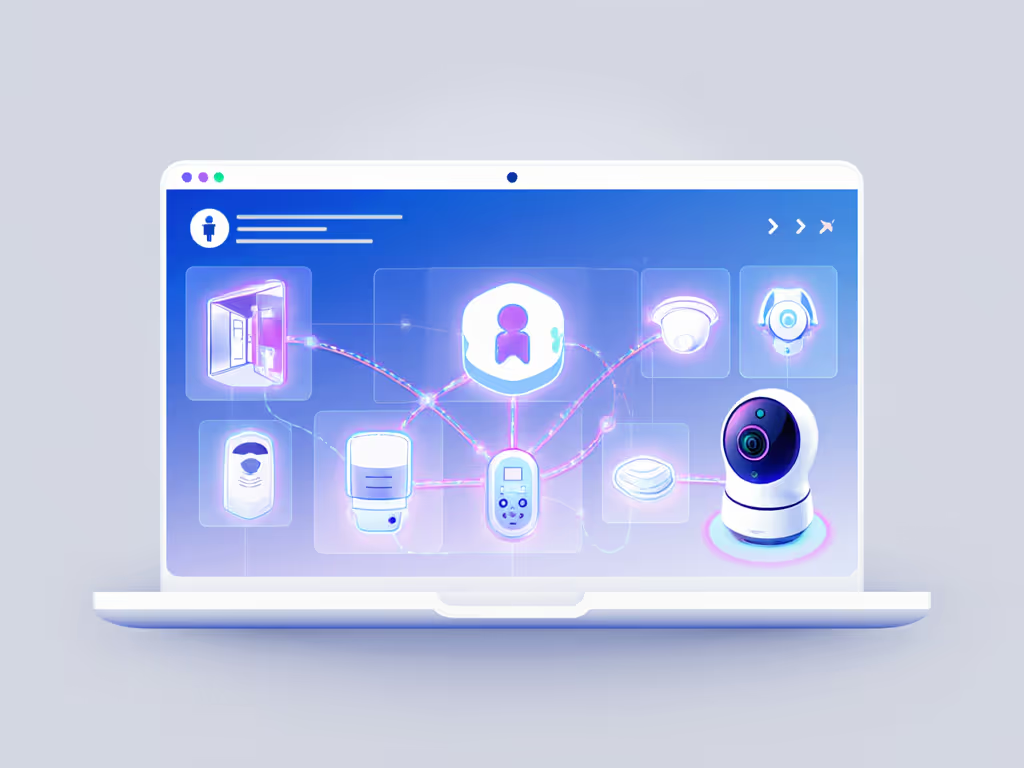
A practical policy stance is: Default deny, then permit with narrow, explicit consents once you understand the flow. In data flow diagrams I sketch for families, we trace:
- Nursery → Monitor
- Monitor → Home network
- Network → Vendor cloud
- Vendor cloud → Insurer or analytics partners
Ideally, the last arrow is absent (or at least tightly constrained). For brand-by-brand policies, check our baby monitor data retention guide.
8. How should I document my monitor for future claims while protecting privacy?
You can prepare for claims without turning your monitor into a 24/7 recording of family life.
Baselines:
- Keep receipts, model numbers, and serials for the monitor with your other home inventory records.
- Take one or two photos of the installation (mounting position, cable routing, power source). This also helps demonstrate child-safe cable management if ever in question.
If an incident occurs:
- Export short, relevant clips rather than full-day recordings.
- Store exported clips on encrypted local media (for example, an external drive) instead of leaving everything in the vendor's cloud indefinitely. Prefer keeping everything in-house? Choose SD card baby monitors for local storage without cloud dependence.
- Redact or crop footage when possible to exclude unrelated rooms, people, or screens.
On the device side:
- Review your monitor's retention settings; if cloud recording is enabled by default, align it with your actual needs.
- Periodically audit which accounts and devices have access; remove old babysitter or guest logins.
This approach uses the monitor as a precise tool for claims, not a general-purpose surveillance system.
9. What specific questions should I ask my insurer about baby monitors?
When you speak with your agent or insurer, consider a focused list:
- Do you recognize baby monitors or indoor cameras as safety features for any credits or discounts?
- Are any discounts contingent on using a particular brand, app, or smart-home platform?
- Does participation require continuous data sharing from my devices, or only proof of installation?
- How is video or device metadata treated if submitted with a claim? Who can access it and for how long?
- Does my policy include or offer optional cyber coverage related to connected devices in the home?
- Are there any documentation expectations (photos, receipts, serial numbers) if a monitor is damaged in a covered loss?
- If I later opt out of a smart-home program, does that affect my base premium or only remove the discount?
Having these answers in writing (for example, in a follow-up email) helps you make decisions aligned with your risk tolerance.
10. How do I balance home insurance baby monitoring benefits with privacy and security?
A structured way to think about this is via threat models:
- Assets: your child's safety, your privacy, and your financial protection through insurance.
- Adversaries: opportunistic burglars, casual hackers, data-hungry platforms, and occasionally overbroad requests for footage in disputes.
- Controls: device choice (local vs cloud), encryption settings, account hygiene, and careful participation in insurance programs.
In field work, families are often surprised by how much metadata leaves their network from "ordinary" monitors. Once we replace noisy, cloud-dependent devices with local-first alternatives and align insurance documentation with minimal-necessary evidence, the network goes quiet, and people sleep better.
From there, your next steps for further exploration might be:
- Map your current monitor's data flows: what leaves the house and why.
- Read the fine print on any smart-home or safety-device credits in your policy.
- Decide where you want to sit on the spectrum from maximum discount to maximum local control.
The goal is not to chase every possible baby monitor insurance benefit, but to integrate your monitor into a broader home-safety plan that respects your child's room as a private space, not a data source by default.